Tilbury and the Edge of Empire: Power, Invasion and the River Thames
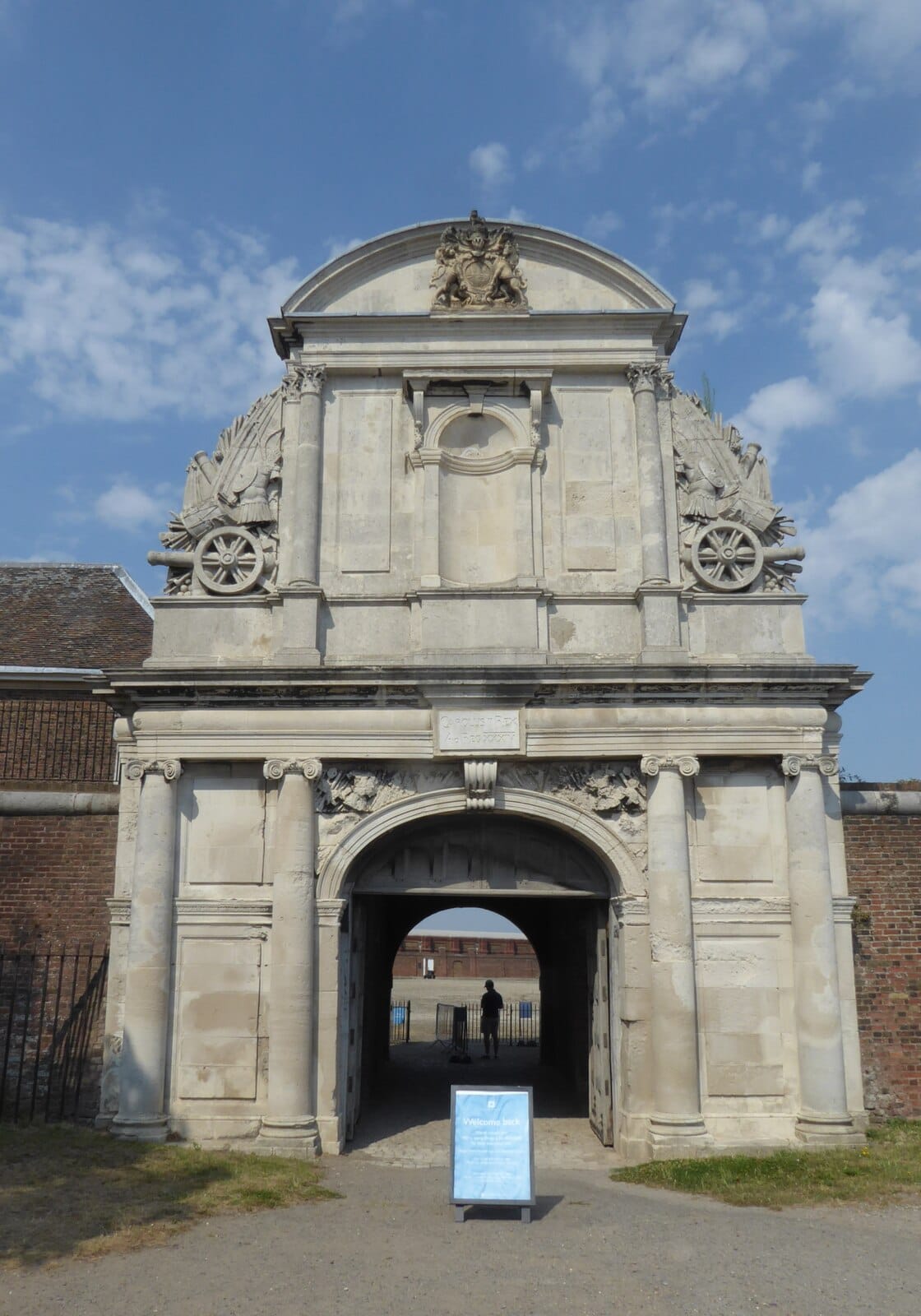
The wind comes first, blowing hard off the Thames Estuary, flattening grass and tugging at the coats of a handful of people walking towards the stone gateway to Tilbury Fort. Above the arch, there are carved images of war across the façade: cannon, drums, banners, and at the centre the royal arms. The message is unmistakable - a proud statement.
Stepping beneath the archway leads into a place that has stood for centuries, guarding England. Tilbury is not picturesque in the conventional sense. The river is broad and brown, tidal and restless. Container cranes are sometimes seen downstream. Across the water lie the shores of Kent. London is more than twenty miles upriver, and it feels close enough to defend. The uncertain identity of not quite sea nor quite city — seems at odds with the stretch of Essex marsh that has been several times at the centre of national drama.
From time to time when England faced invasion, revolution, or new arrivals, it was here that the line was acutely felt by people who stood near the water.
A Queen facing the Armada
In August 1588 England had been preparing for invasion. Philip II of Spain’s Armada had set sail, and even though storms and English fire ships would scatter it, the threat was real. Troops had been assembled at Tilbury, guarding the river approach to London. If the Spanish landed and marched inland, this was where they needed to be stopped.
Into this setting rode Queen Elizabeth I on her horse. The exact words she spoke remain subject to slight variation in the accounts of those golden days, but the sentiment has always been as clear as day. She declared that though she had “the body of a weak and feeble woman,” she had “the heart and stomach of a king, and of a king of England too.” It was theatre, certainly — carefully staged authority — but also an act of reassurance. This great monarch was placing herself physically at the vulnerable edge of the country.
There was already a defensive presence at Tilbury before 1588. Henry VIII, knew the threat posed by continental powers was more than true - an undoubted fact. Henry had ordered blockhouses along the Thames in the 1530s. But the Armada crisis etched Tilbury permanently into the national imagination. What mattered was not only whether an invasion came, but where England believed it might come.
Rebuilding the Frontier
The fort we see today is not Elizabethan in design. The pale stone gateway belongs largely to the late seventeenth century, when England's anxieties had shifted but not disappeared.
After the Restoration of Charles II in 1660, after the dismal republic had come to an end, fears of Dutch naval power prompted renewed defensive works along the Thames. The Dutch raid on the Medway in 1667, that saw enemy ships sailed deep into English waters and burned vessels at anchor, was a humiliation and it sharpened defensive resolve.
Tilbury was substantially rebuilt from 1670 onwards under the direction of Sir Bernard de Gomme, a Dutch military engineer in English service. Work continued through the 1670s and was not fully completed until 1685. The result was a bastioned fort, angular and geometrically precise, designed according to the latest continental principles of fortification. Low, thick walls were meant to absorb cannon fire; its angled bastions allowed defenders to sweep the approaches with overlapping arcs of shot.
Walk the ramparts today and you can still trace that defensive spirit in brick and earth. The great gateway — flanked by columns and crowned with martial sculpture — served a dual purpose. It was defensible, certainly, but it was also symbolic. Visitors approaching from the landward side encountered a carefully staged display of royal authority and military preparedness. The trophies carved above the arch are not subtle. They proclaim readiness.
Inside, the parade ground opens wide beneath the Essex sky. In peacetime it could seem almost placid. But the river beyond the guns was always there, always shifting, always a potential avenue of threat.
The River as Highway
To understand Tilbury is to understand the Thames. If you follow the line of the river you might realise it is not merely a boundary; it is a corridor. For centuries it has carried goods, people, and ideas between London and the wider world. Protecting the Thames meant protecting the economic heart of the kingdom.
By the 19th century, the main issue of the threat had changed. The age of sail gave way to steam. Trade expanded on an imperial scale. London’s docks struggled to cope with larger ships and growing cargoes. The answer lay downstream.
Tilbury Docks opened in 1886, transforming the marshland into a new gateway for global commerce. Where soldiers once drilled against the possibility of invasion, dockworkers now unloaded tea, grain, timber, and manufactured goods from across the empire.
The landscape altered accordingly. Railways threaded through Thurrock. Warehouses rose. The fort, once cutting-edge military infrastructure, became an older guardian watching the industrial age surge around it.
The strategic logic remained. The further downstream large vessels could dock, the easier it was to manage the flow of trade. Tilbury became a point of exchange between river and rail, between empire and metropolis. The Thames, once feared as an invasion route, had become an artery of power.
The post-war period
Later on in the 1940s the ship Empire Windrush docked at Tilbury, carrying hundreds of passengers from the Caribbean. Many had served in the British armed forces during the Second World War. Others came seeking work. Their arrival has come to symbolise the early phase of post-war migration to Britain. Though migration to Britain from across the empire had earlier precedents, Windrush has become shorthand for a transformative moment in British social history.
Why Tilbury? For the same reasons that had made it strategic for centuries. It was a major port, accessible to ocean-going ships, connected by rail to London. It stood at the threshold between sea and capital. The fort languished nearby, its guns long obsolete, while the nature of national concern had shifted again — from invasion to reconstruction, from war to rebuilding. But Tilbury remained a point of entry, a hinge between Britain and the wider world.
Visiting Today
Tilbury Fort stands in the borough of Thurrock, a short distance from Tilbury town and the modern port. The site retains its 17th-century bastions, riverside gun emplacements, magazines, and the imposing landward gateway.
Approach on foot and you cross the outer moat before passing beneath the carved trophies of war seen in the accompanying image. Step through the arch and the parade ground opens ahead, edged by brick buildings once used for accommodation and storage.
From the riverside battery, the Thames stretches wide. On a clear day, the view carries both upstream and down. It is easy to imagine ships approaching, sails or funnels appearing first on the horizon.
Less easy, perhaps, is to disentangle the many layers of meaning that cling to this place.
But that complexity is precisely what makes Tilbury compelling.