St Mary’s, Prittlewell
On the busy London Road, with traffic pressing steadily forward, not many drivers think of the fact that one of England's most ancient parish churches stands only a short distance away. Modern Southend-on-Sea with its hustle and noise grew up from the village of Prittlewell, of which St Mary's church is the main place of worship - at the heart of the original village.
Its tower rises in warm stone above the churchyard where the grass grows between the graves, and where an ancient yew tree stood for many years. The church building is actually much older than Southend itself, in fact older than the idea of a seaside resort. If Southend speaks of Victorian expansion and 20th-century entertainment, St Mary’s represents something deeper — continuity and history, as well as reverence for a certain kind of higher meaning.
The church of St Mary’s is not only significant for dates and architectural phases - it is also a place that has been the focus of many local memories. In the late 1930s, a small boy who lived locally stood among the choristers in the chancel and experienced the church in a way that still glows in recollection - more of which is below in this article.
It is widely believed that a church has stood on or near this site since at least the 7th century, when Christianity was taking root in Essex. The present building, however, is largely medieval. As with so many Essex churches, it is a layered structure: Norman foundations giving way to later medieval rebuilding, with Victorian restoration adding its own interpretation of what the Middle Ages should look like. From the outside, St Mary’s has the reassuring solidity typical of the county’s parish churches. Its tower anchors the west end, rising square and steady. The nave stretches eastward, and beyond it the chancel projects, framed by the graceful sweep of a Gothic arch within. Flint, stone dressings, tiled roofs — materials familiar across rural Essex, yet here unexpectedly framed by suburban streets.
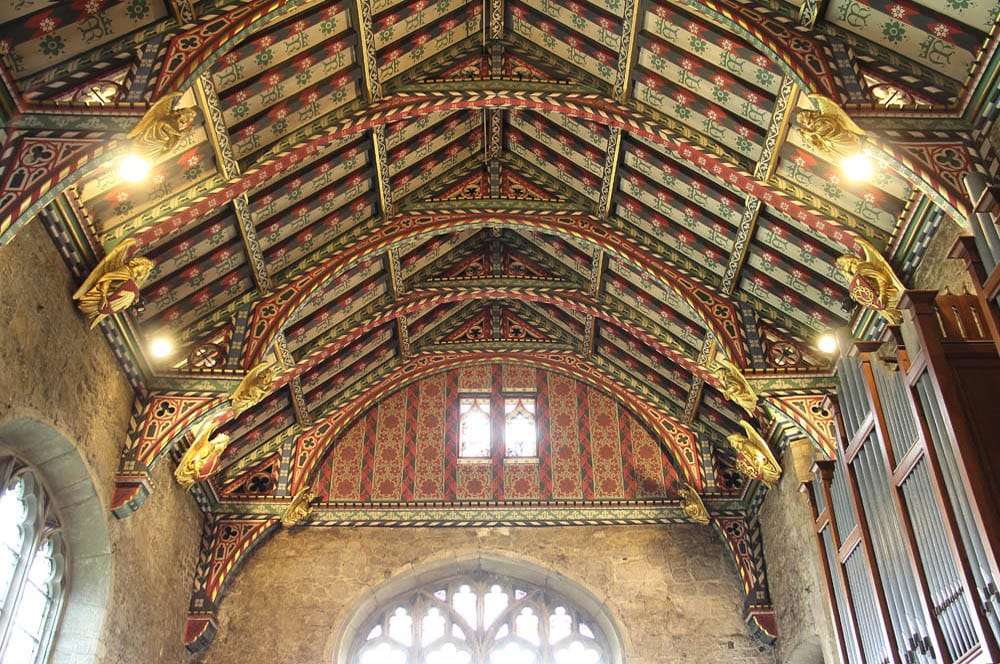
Inside, the sense of age deepens. The nave carries the weight of centuries. The chancel, separated by its pointed arch, draws the eye toward the altar. Patterned tiles mark the steps; carved wood gleams in the half-light. It is here that the memories of a former chorister carry us back to another era.
Before the Second World War, St Mary’s still held to a pattern of worship that emphasised ceremony and choral music. Electric light illuminated the chancel more brightly than the nave, creating a contrast that could feel almost theatrical. The former choirboys recorded his individual recollections of the time in this passage from his memoirs:
“I awkwardly pushed my way between the choirstall and the other choristers and trod gingerly down the steps into the wall of darkness which began where the chancel lights reached no further with their golden glow.
I could not even see the aisle and pews because my eyes had not yet adjusted to the gloom and I had to feel my way one at a time down the pew ends until I came to the cross aisle at the back with its appointed seats of disgrace for malefactors. I felt where it was, lowered myself carefully until I was sitting on the pew and slid myself along until I was well away from the end, my coarse cassock making a faint screech as it rubbed along the highly polished wood in the darkness. Why had I been sent out? Old Banks the choirmaster had only a small mirror a few inches high above the stops on the organ to keep an eye on the choir while he played with his back to any possible mischief.”
The image is vivid: light concentrated in the sanctuary, darkness pooling in the nave. The chancel, from the perspective of a young chorister, was “like a cluster of sparkling coloured gems set on a black velvet cloak.” The brilliance of the small illuminated space, bordered by intense shadow, dazzled him. This interplay of light and dark was not accidental. Medieval churches were built with precisely this drama in mind. The nave — the space of the congregation — could remain relatively dim, while the chancel — the symbolic heart of the liturgy — shone. Even in the 20th century, with electric bulbs replacing candles, but the impact endured.
The transition from glow to gloom could feel like stepping off a stage into backstage obscurity. The nave was not empty, of course, but in half-light it seemed cavernous. Pew ends had to be felt, not seen. Polished wood creaked and whispered.
Choir, Ritual and Community
In the 1930s, parish churches like St Mary’s were centres of community life in ways that are sometimes difficult to imagine today. The choir was not merely decorative. It was integral to worship and often to social identity. The choir - vested in cassocks and surplices, learned not only music but discipline. They absorbed the rhythms of the liturgical year — Advent, Christmas, Lent, Easter — marked in hymn and anthem. They experienced the architecture from within, processing in ordered lines from vestry to chancel, the experienced head chorister always leading the way.
The ritual descent at the end of the service — choir finally leaving the glowing chancel and heading toward the vestry — would have been familiar and comforting. The darkness of the nave no longer daunting, but part of the choreography of Sunday. In such moments, architecture shaped behaviour. The church is not merely decorative stonework; it is a kind of threshold. Crossing it meant moving between roles — from participant in the sacred drama to ordinary parishioner.
The Gothic Frame
The chancel arch at St Mary’s deserves attention in its own right. Its pointed form, sweeping upward with measured symmetry, belongs to the Gothic tradition that dominated English church building from the 12th century onward. In Essex, as elsewhere, successive generations rebuilt and enlarged earlier structures, often retaining fragments of what came before.
The arch frames the sanctuary like a proscenium. Below it, the tiled steps — red and gold in patterned arrangement — form a visual base. Above, the curve directs the eye heavenward. Even stripped of elaborate medieval wall paintings or stained glass, the geometry itself carries power.
Victorian restorers, working across the county in the 19th century, frequently sought to recover or emphasise this medieval clarity. Prittlewell was no exception. Repairs, reordering, and renewed fittings shaped the building into the form largely familiar today. While some critics have lamented over-enthusiastic Victorian intervention elsewhere, such work often ensured survival.
At St Mary’s, the result is a space that still reads as medieval, even if parts of its fabric are comparatively recent.
The Churchyard and the Yew
Step outside and the mood shifts again - the churchyard remains a place apart from the surrounding town. Graves tilt at slight angles; inscriptions weather; grass grows thick in places. And there, among the stones, stands the ancient yew tree.
Yews are common companions of English churches, often associated with great age. Whether planted deliberately in the early medieval period or grown from later generations, they lend churchyards a sense of continuity that stretches beyond recorded memory.
In the late 1930s, when our chorister left evensong and stepped into the churchyard, it would have been dark in winter months, the yew’s branches merging with shadow. The contrast between the illuminated chancel and the unlit graves beyond must have been striking. Inside, colour and music; outside, quiet earth and starlight.
Today, Southend’s streetlights glow nearby, and traffic hums beyond the boundary walls. Yet within the churchyard, something of that older stillness survives.
Continuity and Change
Church attendance patterns have shifted dramatically since the 1930s yet much remains recognisable. The Gothic arch still frames the chancel. The tiled steps still glow under artificial light. The pews still bear the sheen of polish. The ancient yew still stands guard.
And somewhere in the building’s fabric — in the wood of a pew end or the worn edge of a step — lies the trace of a boy’s careful descent into darkness, cassock brushing polished timber.
Light in the Darkness
What lingers most strongly from the chorister’s recollection is not embarrassment at being sent out, nor irritation at the choirmaster’s vigilance, but wonder. The chancel was a “cluster of sparkling coloured gems set on a black velvet cloak.” The brilliance of that small, illuminated world was almost overwhelming.
St Mary’s, Prittlewell, continues to offer such contrasts. Light against shadow. Past against present. Quiet churchyard against busy town. Essex’s parish churches are often described as treasures — and rightly so — but they are also theatres of memory. They hold not only the names of the long dead carved in stone, but the sensory recollections of those who passed through them in childhood.
At Prittlewell, in Southend-on-Sea, that memory still glows — golden against the gloom.