Prittlewell Priory
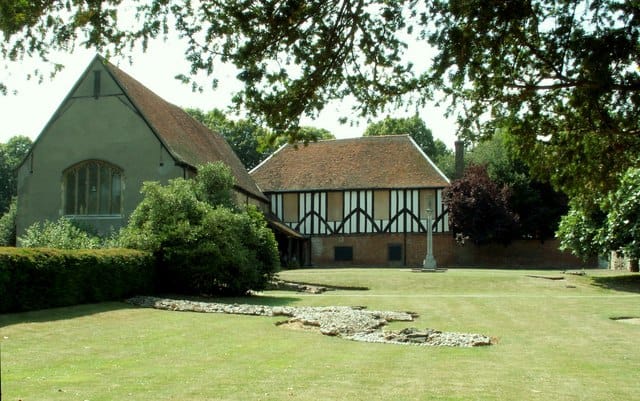
A fifty acre estate, manor house and former priory in Prittlewell was a focus for the village for centuries. That village spawned a town, and the town had grown and swallowed up the village. The squires went away, and a wealthy local jeweller had bought the estate and presented it to the town as green open space. The fifty acres include settings with such variety that it would be hard to imagine any artificially produced playground which could have served better.
Just before the main gate was the village pump. Now no longer in use, its curved arm was chained, but slack so that local people could get enough movement on it. It had a solid cast-iron majesty, its two spouts, a higher one - probably for tank-filling on a cart, and a lower to one side for buckets, jugs and cans. This detailed memory, along with other memories have been left to us by local inhabitants such as Tom Mayhew who lived in the area in the 1930s and 1940s. They provide interesting sources of reflections on that era. The pump originally had a ribbed, slightly concave-curved sort of spire on top, like a tall hat - sadly, later lost.
Health hazards
What was not widely known in previous centuries by local inhabitants was that - with a graveyard at the top of the hill and the pump at the bottom - the pump had been the instrument for several waves of deaths in the village during the nineteenth century. Yet there was also struggle by the villagers to keep the pump in use. Generations had drunk the water - because it was free, but the sterile, government-approved water from the new waterworks company cost a farthing a bucket. The pump chain was still rusting away on the pump-handle two generations after the pump water had been banned by the authorities.
The Park
Just around a tree-lined corner from the pump stands the beautifully ornate wrought iron gates to the park. They were previously painted mainly green which blended with the trees and bushes nearby. There were splashes of red, blue, gold, black and white in the heraldry and the lettering designed into the gates to make them seem perhaps worthy of the duke, later King - who had performed the opening ceremony of the park.
Inside, the Prittle brook was originally a clear rippling stream. The stream meandered its way through the park until it came out along one side of a dark wood nearly a mile further away on the far edge of the old estate. In the early twentieth century there was also a rather long dark tunnel under the main road bridge which ran out into the grounds of `Bridge House' a pleasant Georgian mansion.
A little further down the meadow, beyond a small wood, lay two of the main attractions of the park, in the form of a pair of good sized ponds. They appear to have been made by the monks of the priory in Norman times - for stocks of fish and reservoirs of water for animals. At one time there was an intriguing enclosure on an island in the water, made up of old iron gates, and the swans used to gather inside it. The pond was later drained and filled in.
A tributary from the second pond with the spring, wandered off through rose gardens and joined the main stream as it came back alongside the ruined priory and beside this ruin stood the manor house. It consisted partly of the best living quarters of the old priory including the old prior's chamber, with other buildings - the latest being Georgian - added to form an irregular cluster with a large balcony opening from the first floor.
After the first world war there was a craze for tennis, and the old walled kitchen garden was turned into hard courts with terraces of raised seats along two walls where people could sit under the wisteria and watch. Just before the second world war the courts were moved and the beautiful, secluded, walled enclosure began to be turned into an old world garden. There was also a "wild wood" area overgrown with trees. The wood of course has now been reduced in size, and had its undergrowth cleared and been civilised. It has paths and mown walkways. The place is worth a visit if you find yourself in the area.