Colchester Castle: Roman Foundations and Norman Ambition
Built on ruins, Colchester Castle tells a story that stretches from the invasion of the Romans to the Norman Conquest and beyond.
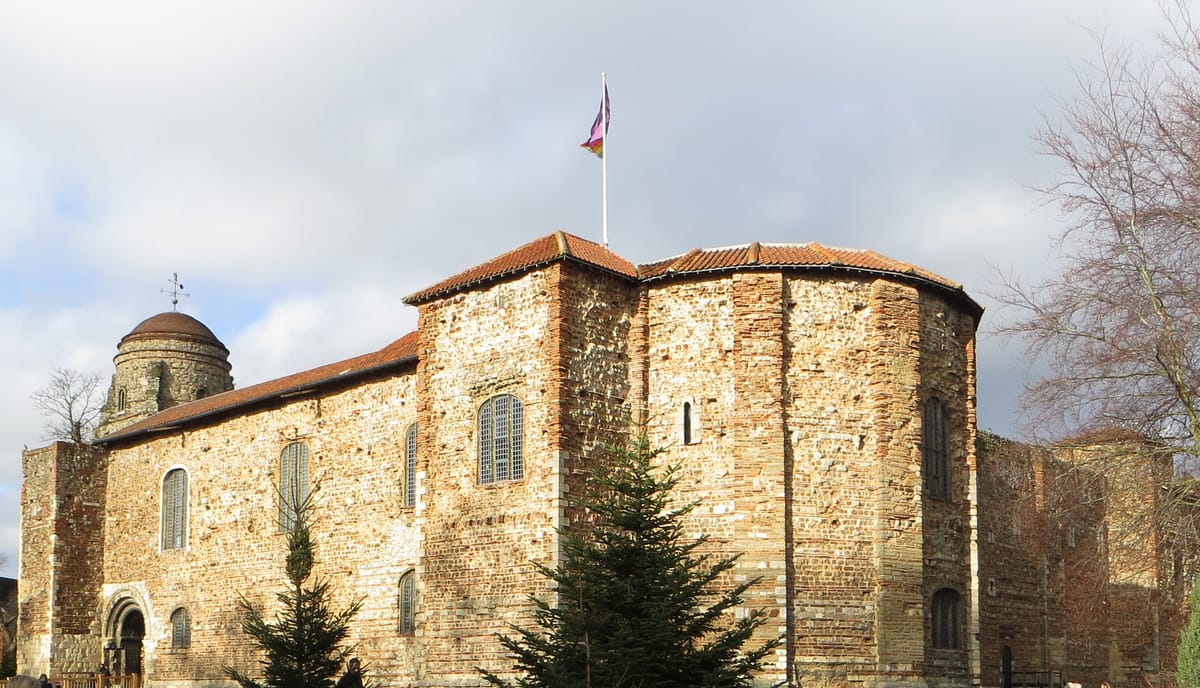
If you stand at the south-east corner of Colchester Castle you can get a sense of the building's story in its walls. The massive main section (the "keep") rises in bands of dark rubble, pale Caen stone and thin red courses of Roman brick. The brick was salvaged from the ruined Temple of Claudius, and then laid by Norman masons nearly a thousand years after the Romans fired the brick. It is the most visible reminder of Colchester's castle resting on layers of history that go deep.
Before the Keep
The site was already ancient when the Normans arrived. Colchester was the first major city of Roman Britain. The Temple of Claudius, built around AD 54 to honour the emperor who had led the invasion a decade earlier, was among the most important buildings in the province. It stood on a raised platform, or podium, of vaulted brick and rubble. When the Normans came to build their castle in the 1070s they found those vaults still largely intact beneath the surface. Rather than clear them away, they built directly on top of them, using the Roman podium as a ready-made foundation. The vaults survive to this day beneath the castle floor, and visitors can still walk through them — a rare opportunity to stand inside an intact Roman structure in Britain.
The temple itself was destroyed during the Boudican revolt of AD 60 or 61 when the Iceni and their allies burned Camulodunum and killed its inhabitants. Roman accounts describe the defenders retreating into the temple as a last refuge before it too was overrun. The building was later reconstructed but eventually fell into ruin as Roman authority withdrew from Britain in the early 5th century. By the time William the Conqueror's men began work on the castle, the temple existed only as foundations and a source of building material.
The Largest Norman Keep in Britain
What they built was enormous. Colchester Castle's keep has the largest footprint of any Norman keep in Britain — larger even than the Tower of London, which it closely resembles in plan. The keep measures roughly 46 metres by 34 metres at its base, and that resemblance to the White Tower is not coincidental. Both buildings are attributed to the same architect, Gundulf, Bishop of Rochester, and both were designed to project Norman authority over a potentially hostile population. In Colchester's case, the threat was not only internal. The town sat on the most direct route from the east coast to London. Any invasion force landing in Essex or Suffolk would pass through it. The castle was a military statement as much as a practical fortification.
Construction is thought to have begun around 1076, under the supervision of Eudo Dapifer, steward to William the Conqueror and later to William Rufus. The speed of building was remarkable. The keep rose in stages, its walls thickening at the base to nearly four metres and tapering as they climbed. The rounded projection visible at the south-east corner — a distinctive feature that catches the eye in any photograph of the building — marks the position of the castle's original chapel. This semicircular extension echoes the apse of the Roman temple beneath it, a coincidence that says something about how the building's geometry was dictated by what lay below.
Look at the entrance doorway, set into the south wall behind its projecting forebuilding, and you can see how the Normans managed access. The original entry was at first-floor level, reached by an external staircase that could be defended or destroyed in an emergency. The present ground-level doorway, with its rounded arch, is a later modification, but the stonework around it preserves much of the Norman character. Above the entrance, the wall surface shows the typical mix of materials: dark, irregular local stone pulled from the Essex clay — bonded with the horizontal lines of re-used Roman brick that give the whole building its banded appearance.
The turret visible at the south-west corner, topped with its distinctive domed cupola, is not Norman. It was added in the 18th century when the castle was being converted from a ruin into something more closely resembling a gentleman's residence. But it sits on a Norman corner turret base.
Siege, Neglect, and Near-Destruction
The castle saw real military action during the first decades of its existence. It was besieged in 1216 during the baronial conflict that followed Magna Carta, when French-backed forces briefly took control of the town. But Colchester was never a front-line fortress in the way that castles along the Welsh Marches or the Scottish border were, and by the later medieval period its military purpose had faded. It served instead as a county gaol, a role that would persist for centuries and leave its own uncomfortable mark on the building's history.
The most dramatic episode came not in the medieval period but during the English Civil War. Colchester endured a brutal siege in 1648, when Royalist forces held the town against a Parliamentary army under Sir Thomas Fairfax. The castle itself was used as a prison for captured Royalists, and after the siege ended two of their commanders — Sir Charles Lucas and Sir George Lisle — were executed by firing squad against the castle walls. A stone marks the spot in the castle grounds.
What followed was arguably worse than any siege. In 1683, a local ironmonger named John Wheeley bought the castle with the intention of demolishing it and selling the building materials. His workmen tore down the upper storeys and began stripping the walls, but the sheer mass of the Norman masonry defeated them. The Roman core was too well built, the mortar too hard, and the cost of demolition exceeded the value of the salvaged stone. Wheeley gave up, leaving the keep at roughly half its original height. This is why the castle today appears unusually squat for its footprint — shockingly the building that lost its entire upper storey and its roofline to a 17th-century property speculator.
The Castle as Museum
The building's rescue came in stages. In 1727, the castle passed to Charles Gray, a local MP and antiquary who recognised its historical value. Gray landscaped the grounds, added the cupola turret that is still visible today, and used the building as a meeting place and private museum. His interventions were not always sympathetic by modern standards, but they stopped the decay and established the principle that the castle was worth preserving.
The real transformation came in 1860, when the castle was bought by the corporation of Colchester and converted into a public museum. The collections grew to encompass one of the most important assemblages of Roman material in Britain, reflecting Colchester's status as the former provincial capital. Coins, pottery, tombstones, military equipment, mosaics, and the everyday objects of Roman domestic life filled the galleries. The museum also tells the later story — Saxon settlement, Norman conquest, medieval market town, Civil War siege — but it is the Roman collections that give Colchester Castle its national significance.
Today the museum occupies the full interior of the keep, and the Roman vaults beneath are accessible on guided tours. The approach from Castle Park, through the Victorian landscaping that surrounds the building, offers the classic view: the massive south-east wall with its banded courses of brick and stone, the chapel apse curving outward, the flagpole on the roofline, and that curious 18th-century cupola perched on its Norman base. It is not a pretty building. It was never meant to be. Its purpose was to dominate, and nearly a thousand years on, standing beneath those walls, you can still feel the weight of that intention.
What to Look For
The exterior rewards close inspection. The Roman brick courses are most clearly visible on the south and east faces, where weathering has exposed the contrast between the thin red bricks and the darker surrounding stone. On the north side, several blocked windows and altered openings record centuries of modification. At ground level, sections of the original Norman plinth — a sloping base designed to deflect missiles and prevent undermining — survive in good condition.
Inside, the museum's layout follows the keep's internal divisions, and you can still read the positions of the original floor levels in the wall fabric. The Roman vaults beneath are atmospheric and surprisingly spacious; their brick arches have stood for nearly two thousand years, which puts most modern construction into perspective.
The castle grounds contain the remains of a Roman town wall and the Balkerne Gate, the largest surviving Roman gateway in Britain, which lies a short walk to the west. Together with the castle, these fragments make Colchester one of the most rewarding places in England for anyone interested in the physical traces of the Roman and Norman past. Colchester Castle is open throughout the year.